
Few places on Earth allow you to stand with one foot in the Northern Hemisphere and the other in the Southern Hemisphere. Just 26 kilometers (16 miles) north of Quito lies one of Ecuador’s most famous attractions, Ciudad Mitad del Mundo, better known as the Middle of the World.
Every year, hundreds of thousands of visitors make the short journey from Ecuador’s capital to experience the famous Equator Monument, explore museums, learn about Indigenous cultures, and capture the iconic photo of standing on latitude 0°.
While many travelers think Mitad del Mundo is simply a monument marking the Equator, the site is much more than that. It is an entire cultural complex featuring museums, restaurants, artisan shops, historical exhibits, and beautiful plazas that celebrate Ecuador’s remarkable diversity.
Whether you’re planning a quick half-day excursion from Quito or spending an entire afternoon exploring every exhibit, this guide covers everything you need to know before your visit.
By the end of this article, you’ll understand the history behind the monument, discover the best attractions inside Ciudad Mitad del Mundo, learn practical travel tips, and find out why this landmark remains one of Ecuador’s most visited destinations.
Table of Contents
Where Is the Middle of the World?
Ciudad Mitad del Mundo is located in the parish of San Antonio de Pichincha, approximately 26 kilometers north of Quito.
Despite its close proximity to Ecuador’s capital, the landscape changes noticeably during the drive. The dense urban neighborhoods gradually give way to rolling hills, volcanic scenery, and expansive valleys before the monument appears in the distance.
The complex sits at an elevation of roughly 2,483 meters (8,146 feet), so visitors should expect cooler temperatures than many other equatorial destinations around the world.
Because of its convenient location, Mitad del Mundo has become one of the most popular day trips from Quito.
Why Is Ecuador Called the Middle of the World?
The country’s very name comes from the Equator.
The word Ecuador literally means “equator” in Spanish, making it one of the few nations named after a geographic feature.
During the 18th century, European scientists traveled to what is now Ecuador to determine the exact shape of the Earth. Their groundbreaking expedition helped confirm that the planet is slightly flattened at the poles rather than being a perfect sphere.
These scientific observations eventually inspired the construction of a monument commemorating the location where the Equator crosses South America.
Today, visitors from around the world travel here simply for the experience of standing at one of Earth’s most famous imaginary lines.
The History of Mitad del Mundo
The story of the Middle of the World begins long before tourists arrived with smartphones and selfie sticks.
In 1736, the French Geodesic Mission traveled to the region to measure a section of Earth’s meridian near the Equator. Their work represented one of the greatest scientific expeditions of the Enlightenment.
Working alongside Spanish and local scientists, the expedition spent years making precise astronomical observations across the Andes.
Their calculations helped settle a major scientific debate of the time by proving that Earth bulges slightly around the Equator.
To commemorate this remarkable achievement, Ecuador later constructed a monument marking the approximate location identified by those early scientists.
The original monument was much smaller than today’s structure. During the late twentieth century, it was replaced by the larger pyramid-shaped monument visitors see today.
Although modern GPS measurements show that the true Equator lies roughly 240 meters north of the monument, the historical significance of the site remains unchanged.
For most visitors, the experience is less about standing on an exact mathematical coordinate and more about celebrating one of humanity’s greatest scientific achievements.
Entering Ciudad Mitad del Mundo
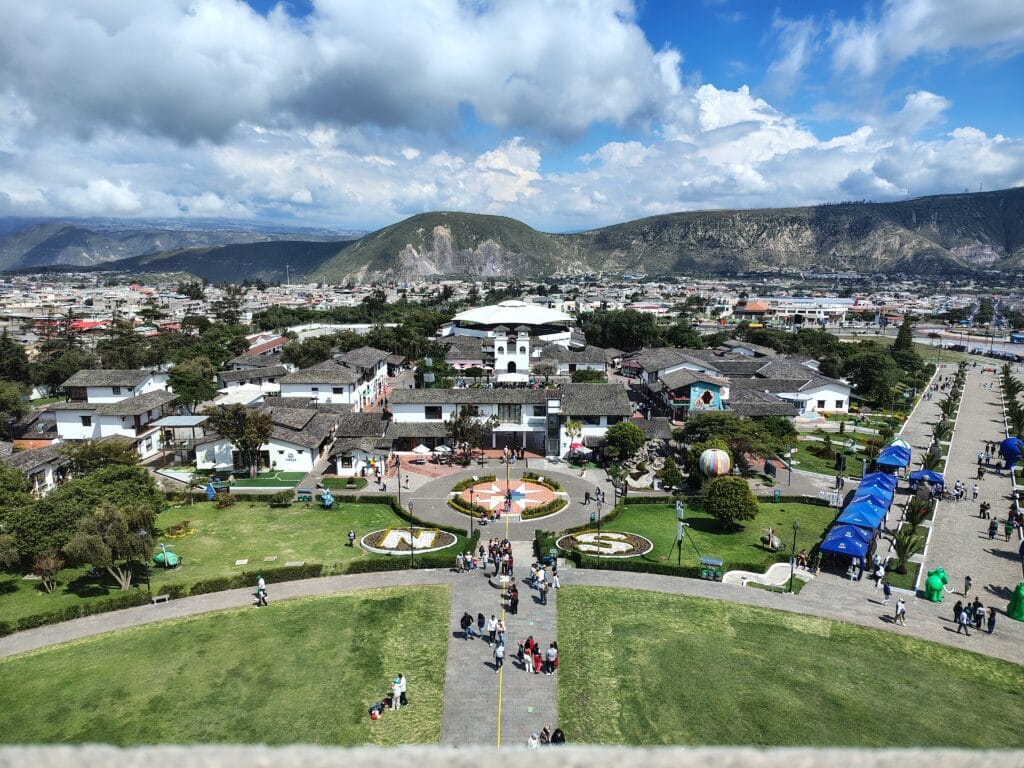
Upon entering the complex, visitors immediately notice its beautifully landscaped grounds.
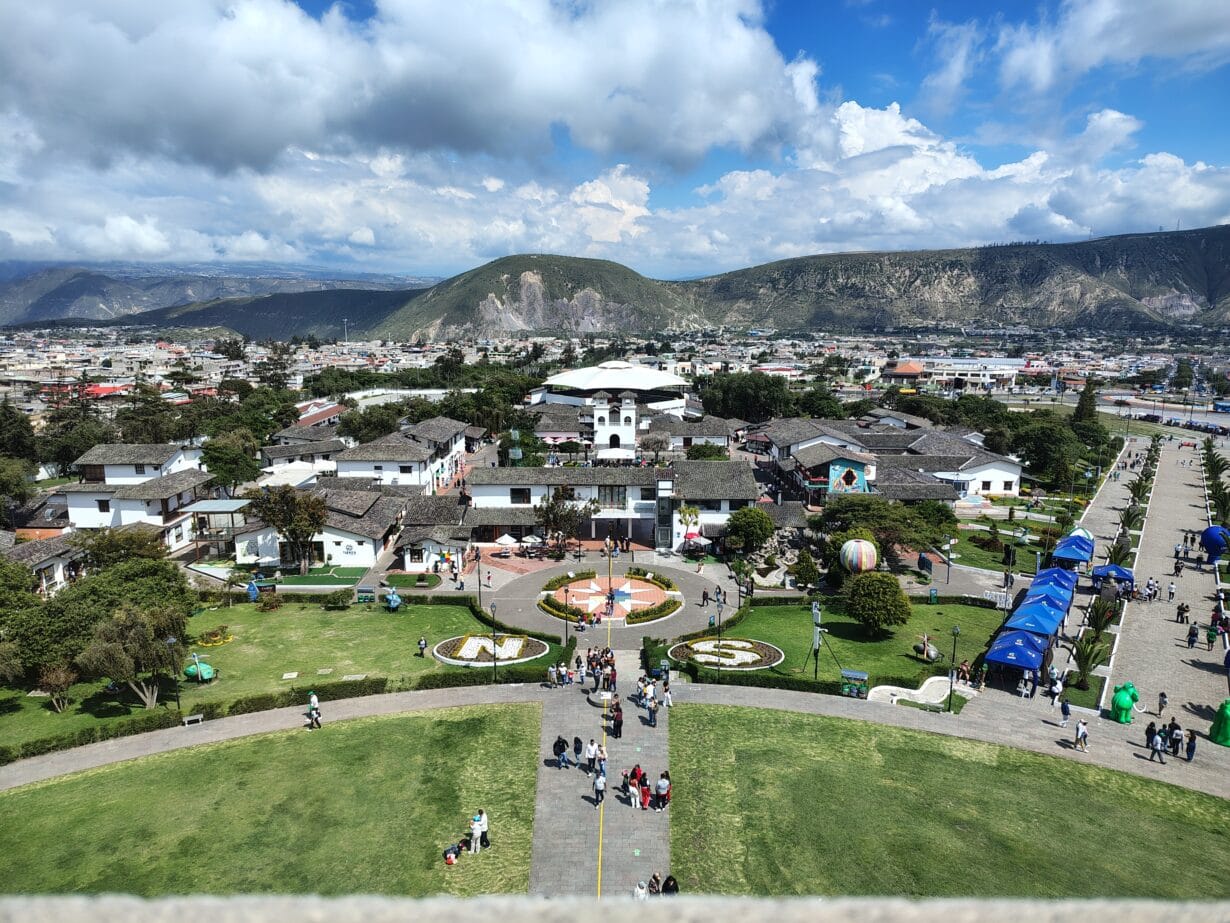
Wide pedestrian walkways lead through manicured gardens toward the towering monument, while white colonial-style buildings house museums, cafés, artisan shops, and cultural exhibits.
Unlike many monuments around the world that offer little more than a photo opportunity, Ciudad Mitad del Mundo feels like a small village dedicated to Ecuadorian culture.
Live music often fills the plazas during weekends, and local artisans display handcrafted souvenirs representing Ecuador’s diverse Indigenous traditions.
Families wander through the gardens while tour groups gather around guides explaining the significance of latitude zero.
The atmosphere is lively without feeling overwhelming.
The Equator Monument
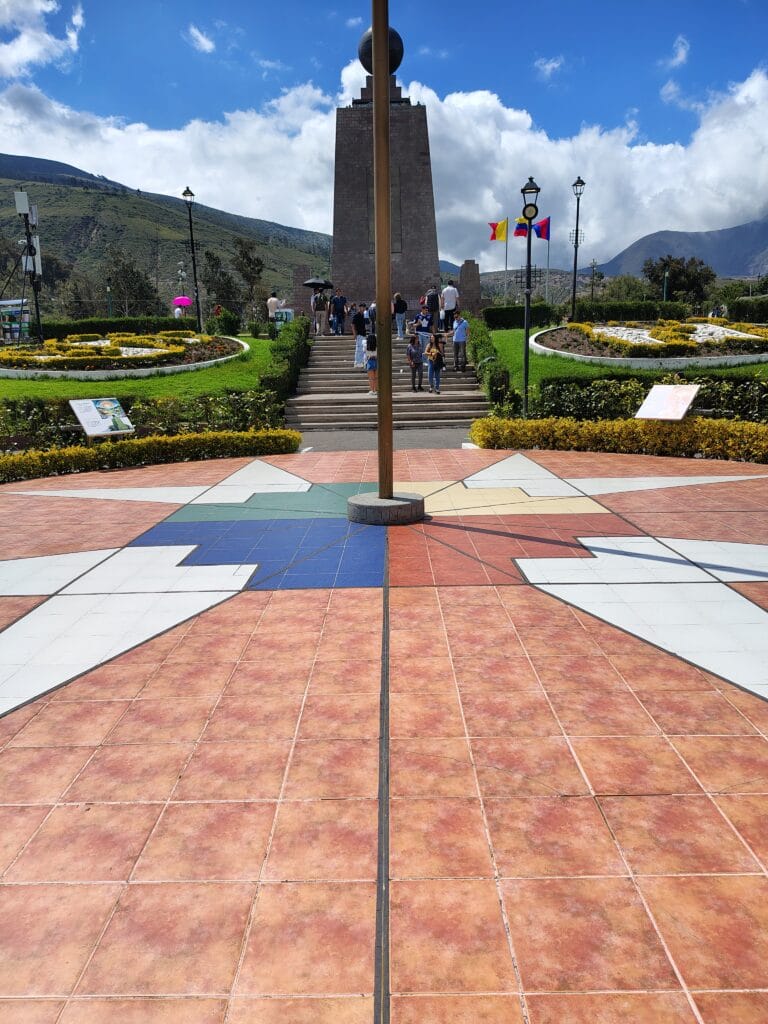
The centerpiece of Ciudad Mitad del Mundo is undoubtedly the imposing Equator Monument.
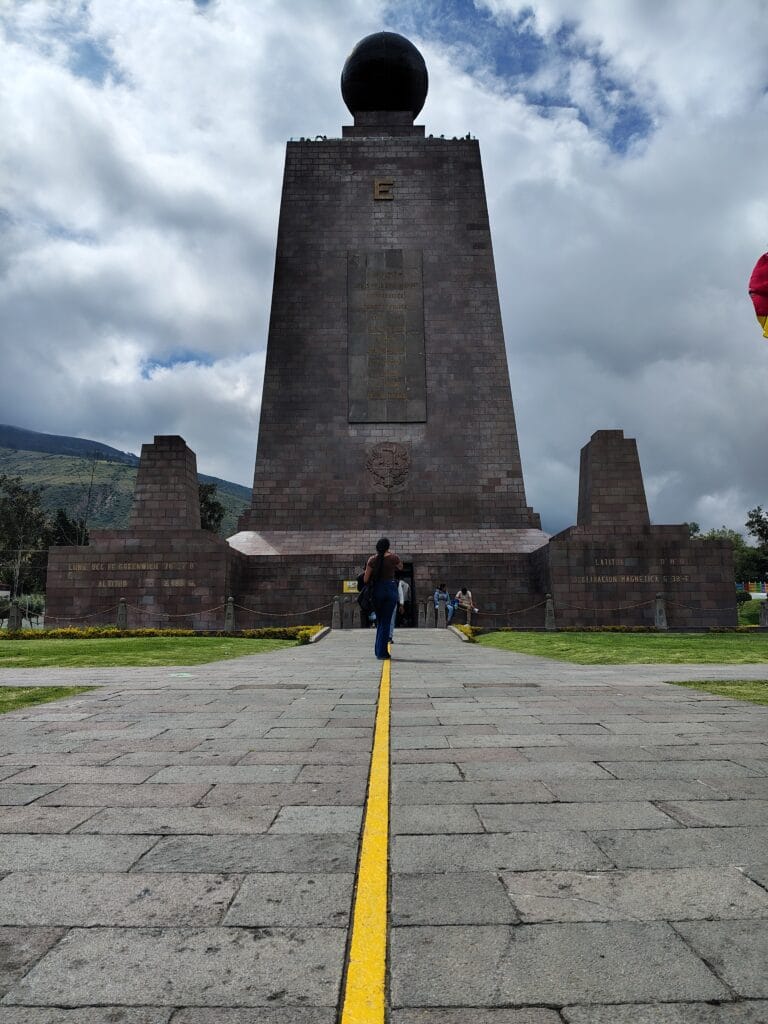
Standing approximately 30 meters (98 feet) tall, the dark stone monument resembles a truncated pyramid topped with a large metallic globe representing Earth.
A bright yellow line painted on the ground extends directly toward the monument, symbolizing latitude zero.
For many visitors, walking along this line becomes one of the highlights of the entire experience.
The monument dominates the landscape and can be seen from nearly every corner of the complex.
Its dark volcanic stone contrasts beautifully against Ecuador’s often dramatic Andean skies, making it a favorite subject for photographers.
Inside the monument, several floors feature exhibits exploring Ecuador’s geography, Indigenous cultures, archaeological discoveries, and the history of the French Geodesic Mission.
At the top, an observation platform provides panoramic views across the surrounding valleys and volcanic mountains.
On clear days, visitors can appreciate just how dramatically the Andes shape the landscape around Quito.
Can You Really Stand in Two Hemispheres?
One of the most common questions visitors ask is whether the monument marks the exact Equator.
The answer is both yes and no.
When the original measurements were made in the eighteenth century, the available instruments were remarkably accurate for their time.
However, modern satellite technology later revealed that the true Equator lies approximately 240 meters (787 feet) north of the monument.
This discovery eventually led to the creation of nearby attractions such as Museo Intiñan, where visitors can stand on a GPS-confirmed equatorial line and participate in demonstrations illustrating the unique effects traditionally associated with the Equator.
Even so, the Mitad del Mundo Monument remains the historical and symbolic heart of Ecuador’s equatorial heritage. Its significance extends beyond geographic precision, representing centuries of scientific exploration and cultural identity.
Exploring Ciudad Mitad del Mundo
Standing on the Equator may be what draws visitors to Mitad del Mundo, but the monument is only the beginning of the experience.
After spending time in the central plaza, I quickly realized that the complex is designed to be explored slowly. Colonial-style streets branch away from the monument, leading visitors through museums, artisan shops, restaurants, gardens, and cultural exhibits that showcase Ecuador’s remarkable diversity.
Instead of rushing to the observation deck and leaving, plan to spend at least three or four hours wandering through the grounds. Every corner reveals something different, from Indigenous traditions preserved through generations to colorful murals celebrating Ecuador’s wildlife and modern artistic expression.
The experience feels less like visiting a monument and more like walking through a small cultural village.
Climbing the Monument
Although the monument dominates the skyline, many visitors are surprised to discover that its interior functions as a museum.
Several floors of exhibits introduce Ecuador’s geography, archaeology, and Indigenous cultures before visitors reach the observation deck near the top.
The climb is gradual, with each level offering a chance to pause, explore, and appreciate the country’s extraordinary cultural diversity.
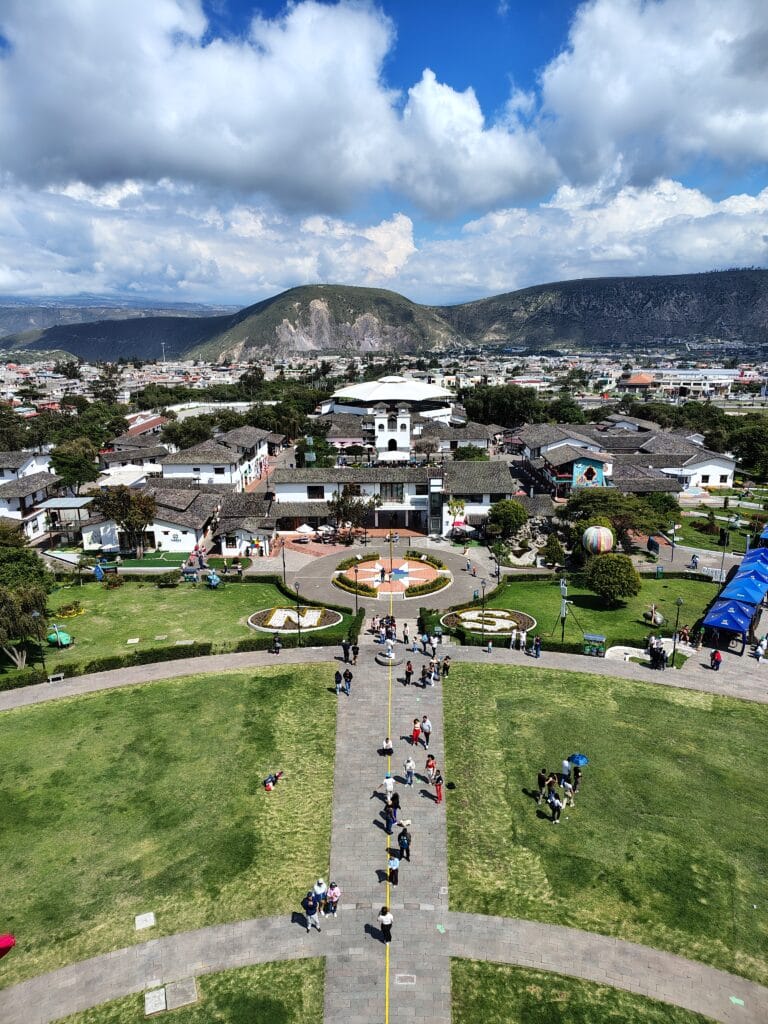
From above, the layout of the complex becomes much easier to appreciate.
The monument sits at the center, surrounded by gardens, museums, artisan shops, cafés, and small plazas connected by pedestrian streets. Beyond the walls, the northern Andes stretch toward the horizon beneath ever-changing clouds.
Because Quito sits high in the mountains, weather conditions change quickly. During my visit, sunlight and shadow moved continuously across the landscape, giving every photograph a slightly different mood.
For photographers, this observation deck is easily one of the best viewpoints in northern Quito.
Discovering Ecuador’s Indigenous Cultures
One of the highlights of climbing the monument is the Ethnographic Museum.
Rather than focusing solely on ancient artifacts, the museum introduces visitors to the Indigenous peoples who continue to shape Ecuador today.
Although Ecuador is one of South America’s smaller countries, it officially recognizes fourteen Indigenous nationalities living throughout the Andes, Amazon, and Pacific Coast.
Each has its own traditions, languages, clothing, music, ceremonies, and worldview.
Walking through the exhibits transforms Mitad del Mundo from a simple tourist attraction into a fascinating introduction to Ecuador itself.
The Peoples of the Amazon
The Amazon occupies nearly half of Ecuador’s territory, yet relatively few visitors experience this vast rainforest firsthand.
The museum brings the Amazon closer through detailed displays that recreate traditional clothing, ceremonies, and daily life.
One of the first exhibits features an Amazonian spiritual leader dressed in brilliantly colored feathers and ceremonial attire.
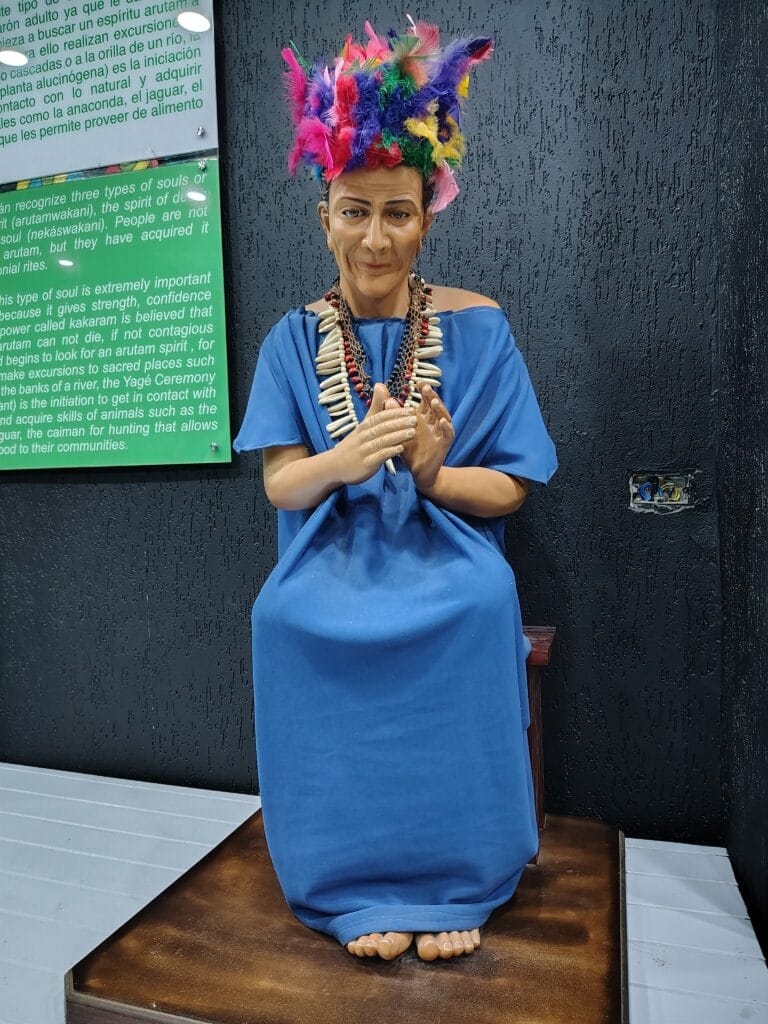
For many Amazonian communities, the rainforest is much more than a place to live.
It is a sacred landscape where rivers, waterfalls, animals, and forests are believed to possess spiritual significance.
The museum explains how elders have traditionally passed knowledge from one generation to the next through oral storytelling, ceremonies, and close observation of nature.
These traditions continue today among several Indigenous nationalities throughout Ecuador’s Amazon.
Spiritual Traditions and Healing
Nearby, another exhibit expands on Amazonian spirituality.
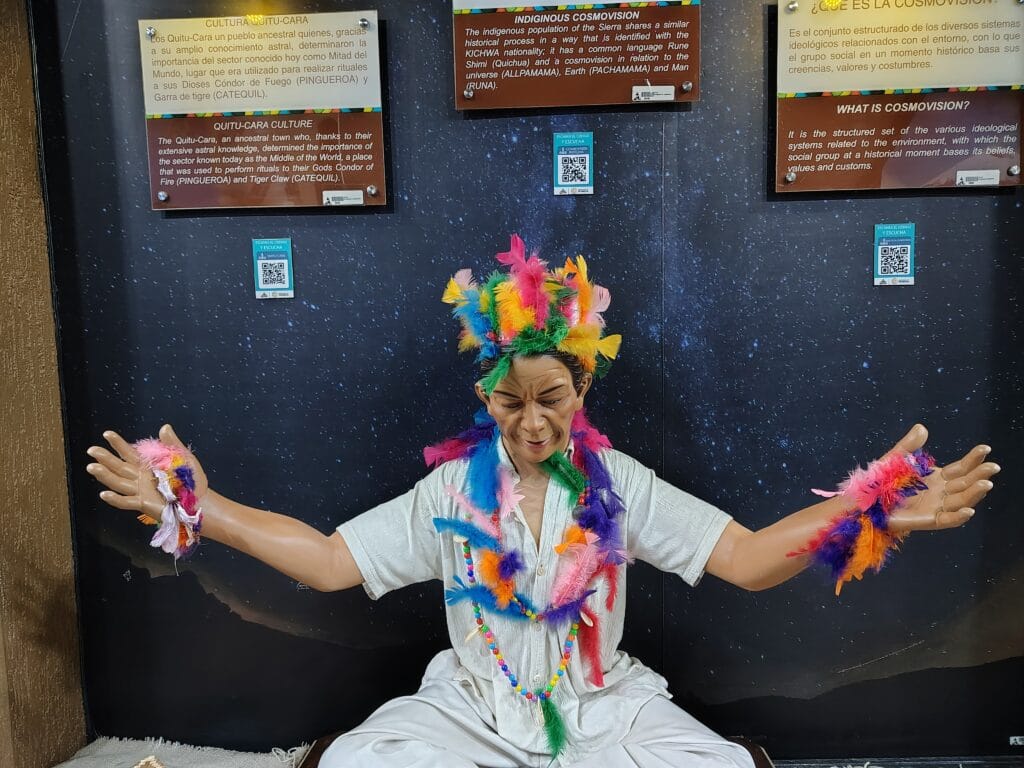
Traditional healing practices combine extensive botanical knowledge with spiritual beliefs that have developed over centuries.
Many rainforest plants displayed throughout the museum are still used by Indigenous healers for medicinal purposes.
Rather than separating medicine, spirituality, and community life, these traditions often view them as deeply interconnected.
For visitors unfamiliar with Amazonian cultures, the exhibits provide valuable context while encouraging respect for knowledge systems that remain alive today.
Everyday Life in the Rainforest
Not every exhibit focuses on ceremonies.
Some of the most interesting displays highlight ordinary daily activities that have sustained Amazonian communities for generations.
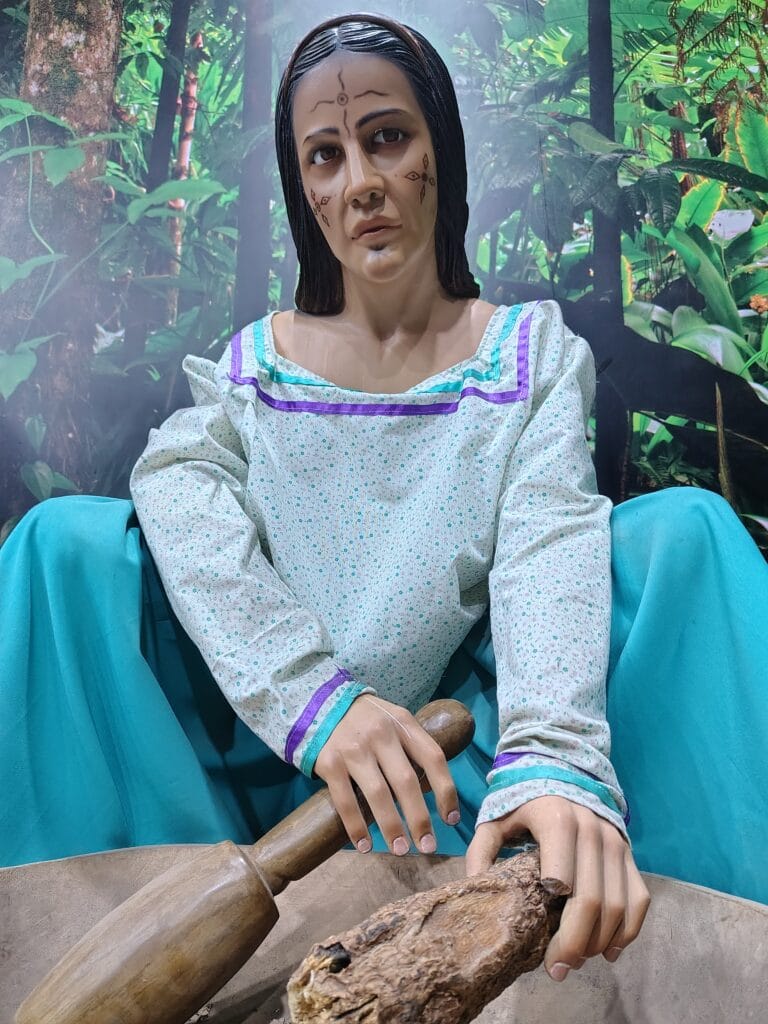
One display shows a woman preparing food using stone grinding tools similar to those used for centuries.
Nearby explanations describe how crops such as cassava remain central to Amazonian diets.
Visitors often spend only a few moments looking at this exhibit, but it quietly illustrates something important.
Civilizations are built not only through rulers and monuments but through everyday activities like farming, cooking, weaving, and raising families.
Family, Community, and Tradition
Another exhibit highlights the importance of family life within Indigenous communities.
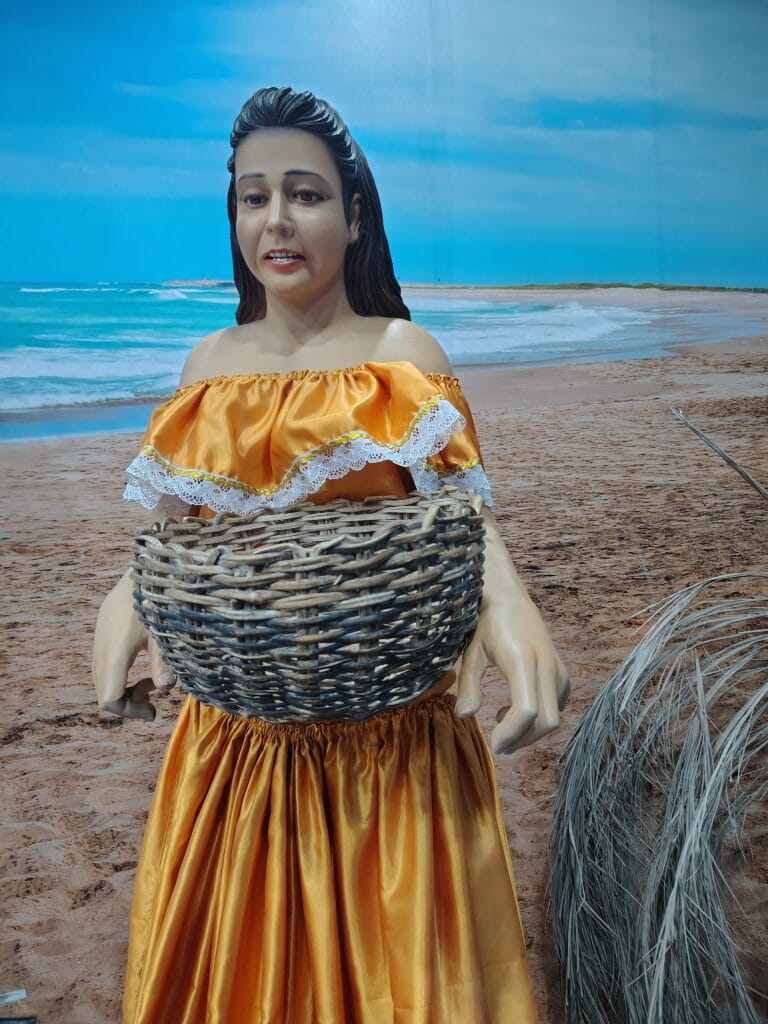
Large woven baskets have historically been used to transport crops, gather forest products, and carry goods to local markets.
Displays like these remind visitors that traditional knowledge often develops through countless small skills passed from parents to children over many generations.
These everyday practices form the foundation of every culture.
Ancient Civilizations Before the Incas
One of the museum’s strengths is that it doesn’t present Ecuadorian history as beginning with the Inca Empire.
Long before the Incas expanded northward, sophisticated civilizations already flourished throughout present-day Ecuador.
These societies developed agriculture, metallurgy, pottery, trade routes, and ceremonial centers that influenced later cultures across the Andes.
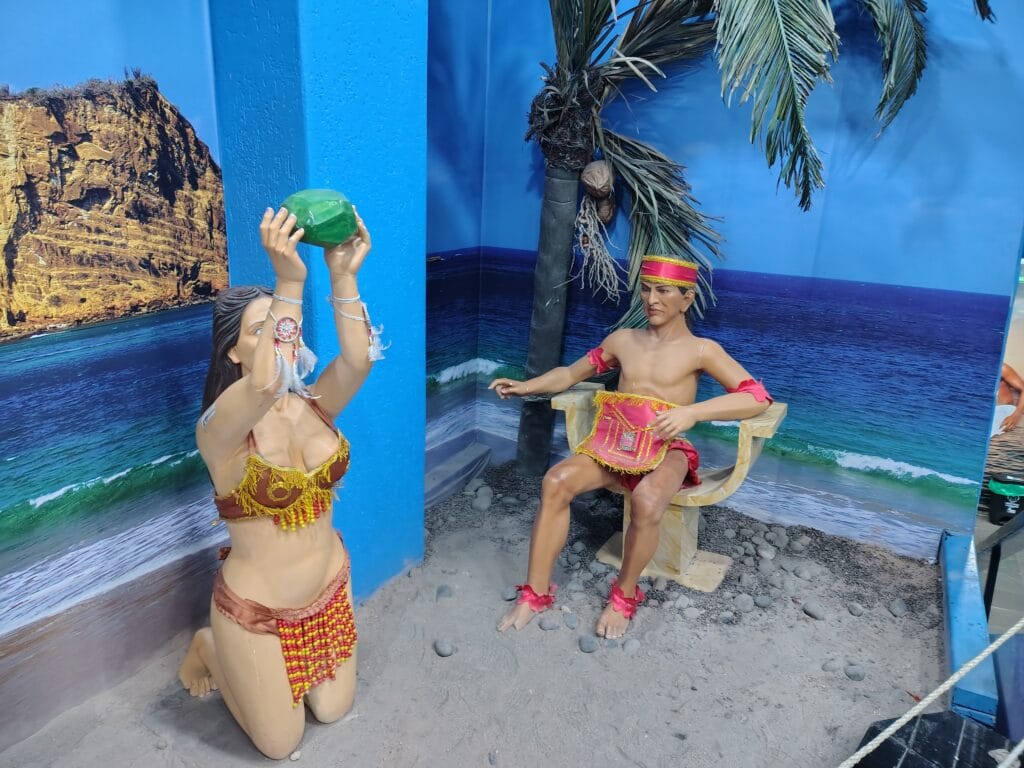
Nearby, another exhibit focuses on ceremonial traditions associated with coastal societies.
These exhibits provide welcome historical depth, helping visitors appreciate that Ecuador’s story extends back thousands of years.
Afro-Ecuadorian Heritage
The museum also celebrates the contributions of Afro-Ecuadorian communities, particularly those living along Ecuador’s Pacific coast.
Music plays a central role in this section.
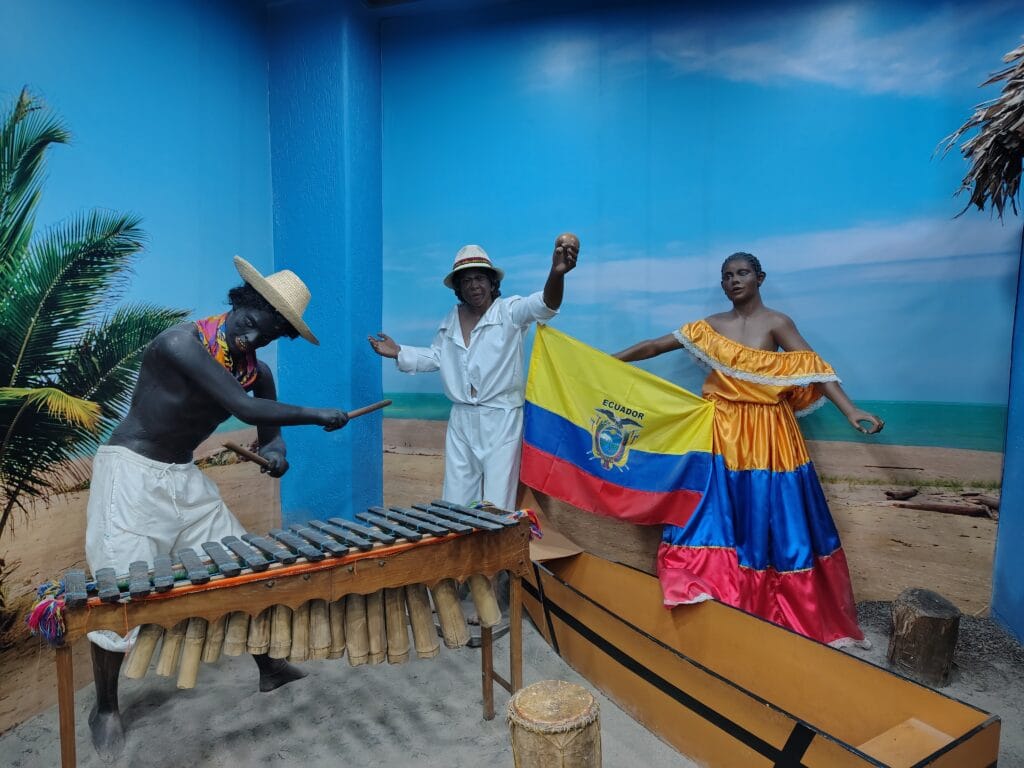
Traditional marimba performances combine percussion, dance, and storytelling into celebrations that continue throughout coastal Ecuador today.
Recognized by UNESCO as Intangible Cultural Heritage, these musical traditions represent one of the country’s most vibrant cultural expressions.
Ecuador’s Festivals Come to Life
One of the most engaging sections of the Ethnographic Museum is its celebration of Ecuador’s festivals. Instead of relying on text panels alone, the museum recreates these events with life-sized figures, elaborate costumes, and handcrafted masks that immediately capture visitors’ attention.
These exhibits demonstrate that Ecuador’s identity is shaped by a blend of Indigenous traditions, Spanish colonial influences, and African heritage. Although each region celebrates in its own way, the festivals share a common purpose: bringing communities together through music, dance, storytelling, and faith.
Walking through this part of the museum feels like stepping into celebrations that have been passed down for generations.
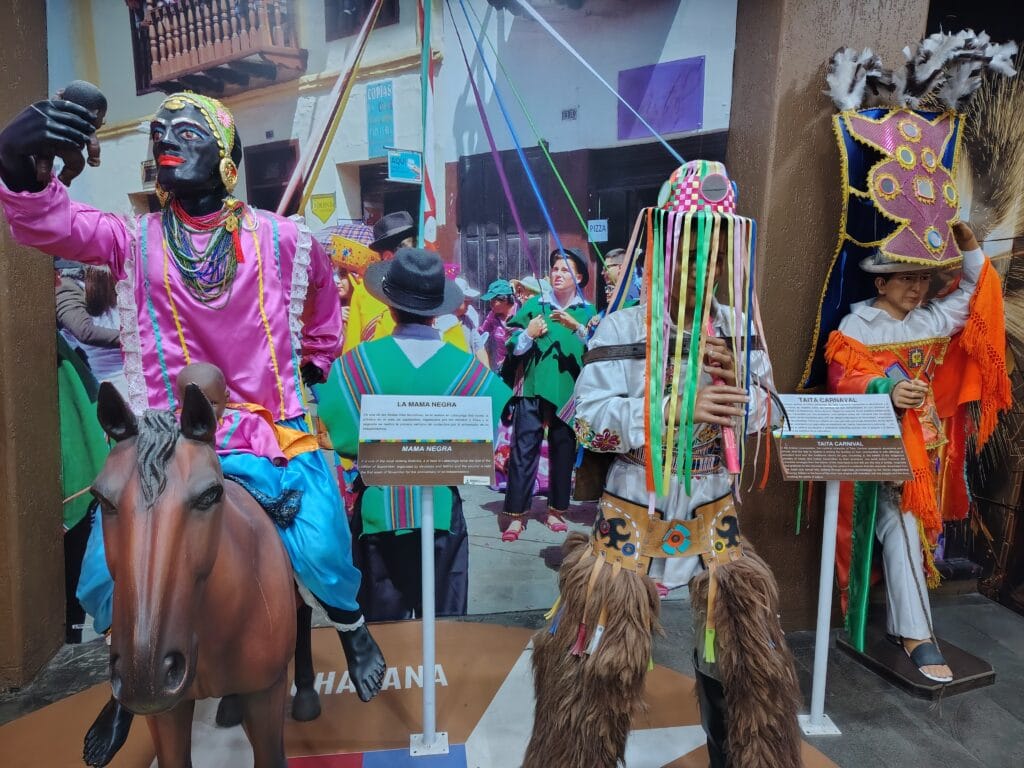
La Diablada de Píllaro
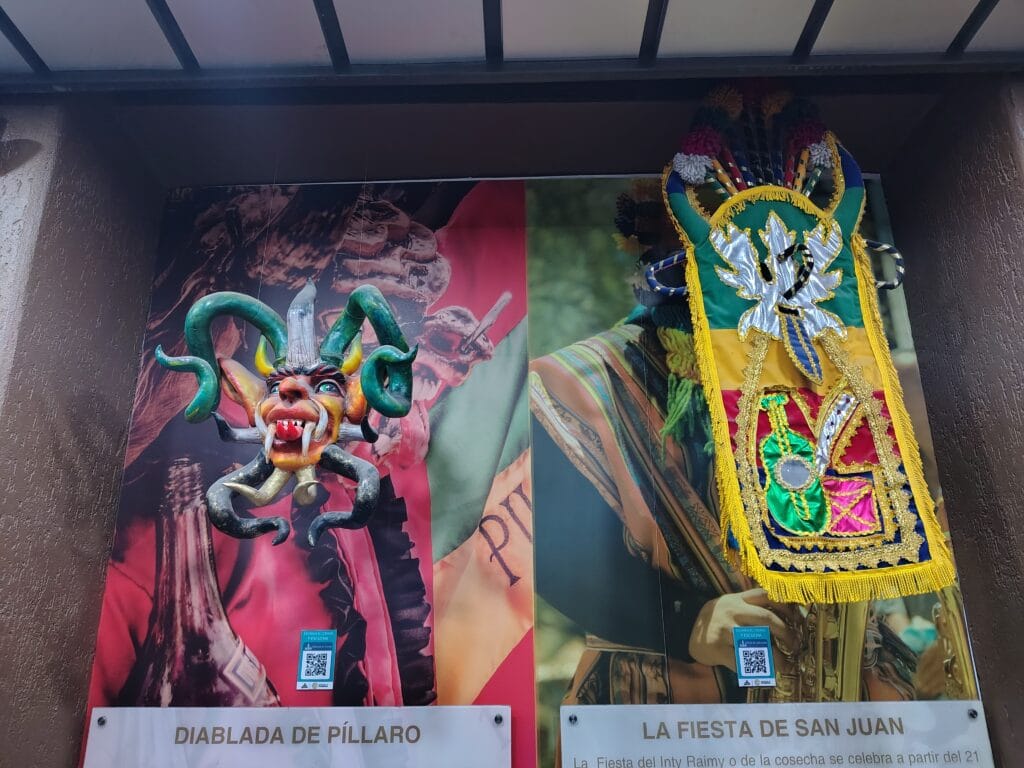
One display immediately draws visitors because of its striking craftsmanship.
The elaborate devil masks represent La Diablada de Píllaro, one of Ecuador’s most famous festivals. Held each January in the town of Píllaro, the celebration fills the streets with dancers wearing hand-carved masks, embroidered costumes, and dramatic capes.
Although the devil imagery may seem surprising at first, the tradition symbolizes much more than religion. Historians generally view the festival as a blend of Catholic symbolism and Indigenous resistance, preserving local identity while incorporating elements introduced during the colonial period.
Each mask is unique, and many are carved by artisans who have spent decades perfecting their craft.
Shopping for Authentic Ecuadorian Crafts
After exploring the museum, the artisan village offers a chance to slow down and browse locally inspired handicrafts.
Unlike many tourist attractions where souvenir shops feel interchangeable, the stores at Ciudad Mitad del Mundo showcase Ecuadorian craftsmanship through woven textiles, carved wood, ceramics, jewelry, paintings, and decorative art.
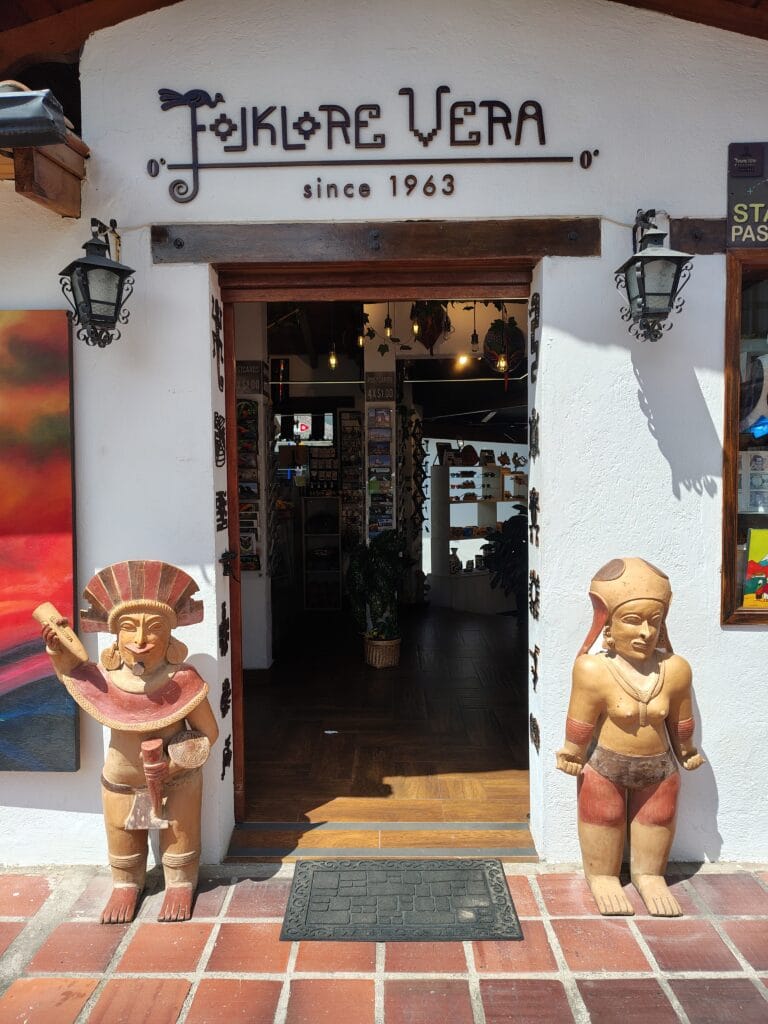
One of the most recognizable shops is Folkore Vera, which has welcomed visitors for decades.
Its entrance, framed by carved Indigenous-inspired figures, immediately reflects the country’s rich artistic traditions.
Inside, shelves are filled with handcrafted items that make meaningful souvenirs while supporting Ecuadorian artisans.
Street Art Adds a Modern Perspective
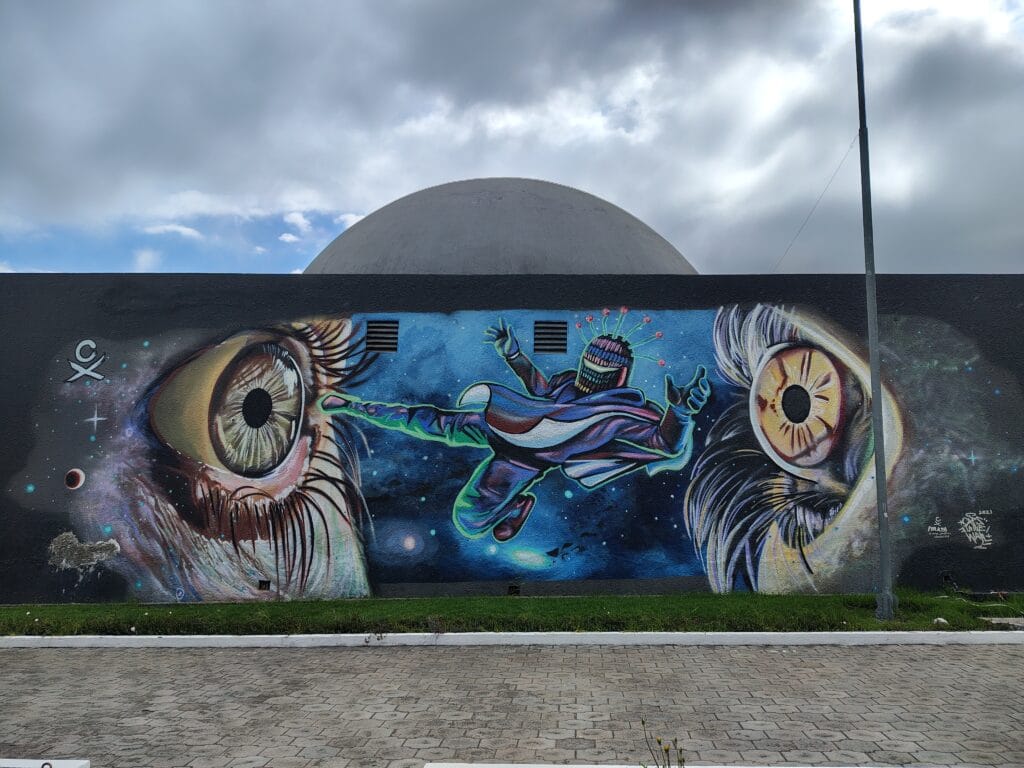
While much of Ciudad Mitad del Mundo focuses on history and tradition, the complex also embraces contemporary Ecuadorian art.
Colorful murals brighten several buildings, creating an unexpected contrast with the colonial-style architecture.
One mural immediately caught my attention with its bold use of color and expressive design.
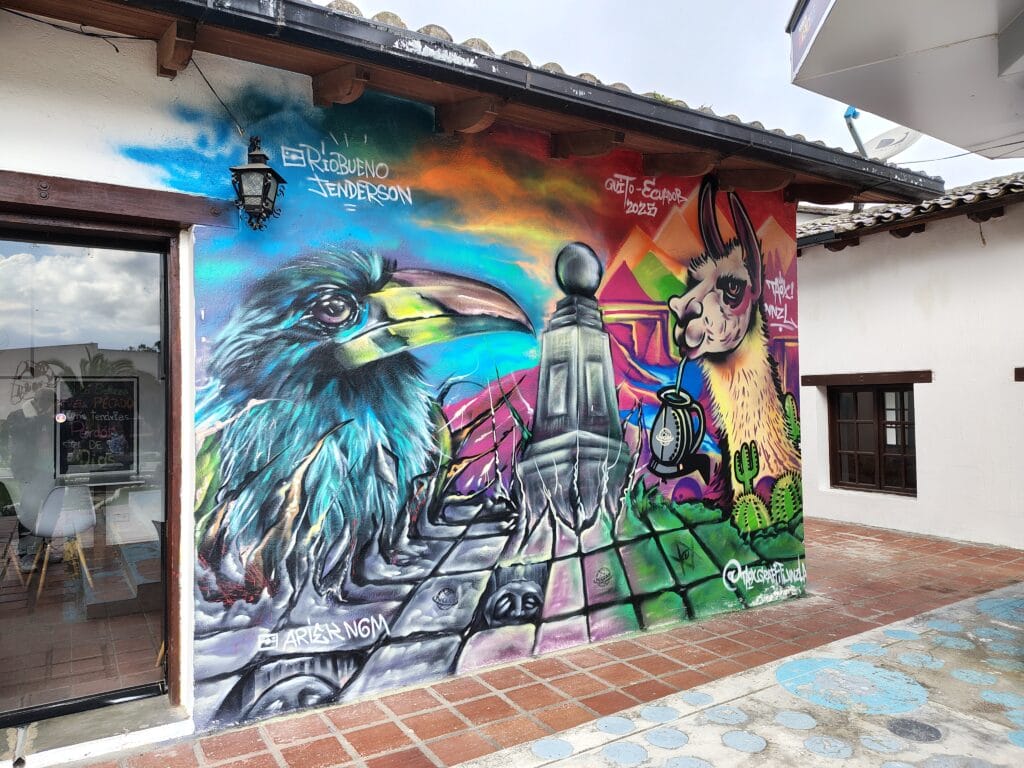
Nearby, another mural celebrates two of Ecuador’s most recognizable symbols.
A majestic Andean condor spreads its wings above a llama, combining wildlife, mountains, and Indigenous symbolism into one striking composition.
It serves as a reminder that Ecuador’s identity is not defined solely by the Equator but also by its extraordinary biodiversity and cultural heritage.
A Reminder That the World Is Connected
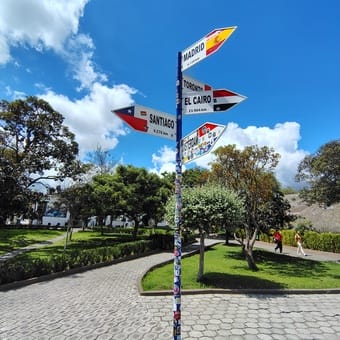
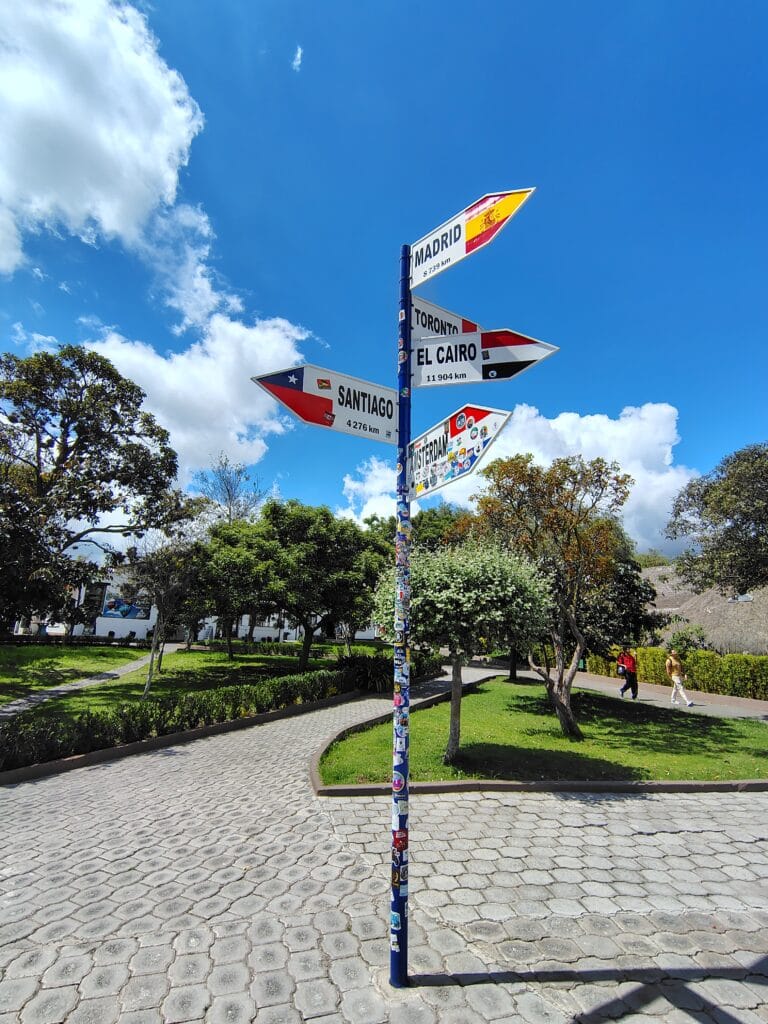
Before leaving the complex, I spent a few minutes at one of my favorite features: the international direction signs.
Pointing toward cities across every continent, the signs provide a simple but meaningful reminder that the Equator connects countries around the globe.
Visitors naturally stop for photos, comparing distances to places they have visited or hope to explore one day.
For a travel enthusiast, it’s a fitting place to pause before continuing the journey.
Planning Your Visit
Opening Hours
Mitad del Mundo is generally open daily, though hours can vary on holidays. Check the official website before your visit for the most up-to-date schedule.
Admission
Tickets include access to the monument and museum. Prices may change, so verify current admission rates before traveling.
How Much Time Should You Allow?
Plan for three to five hours to enjoy the monument, museum, artisan village, shops, restaurants, and photography without feeling rushed.
Best Time to Visit
Weekday mornings are usually quieter than weekends.
If you’re interested in photography, arriving early often provides softer light and fewer people in your shots. The weather in the Andes can change quickly, so don’t be discouraged if clouds roll in. They often create dramatic skies that add character to your images.
Getting There from Quito
The easiest options include:
- Uber or taxi
- Rental car
- Organized day tour
- Public bus from Quito
Travel time is typically 30 to 45 minutes, depending on traffic.
Frequently Asked Questions
Is Mitad del Mundo worth visiting?
Yes. While the monument is the main attraction, the museums, cultural exhibits, artisan village, and panoramic views make it one of the most rewarding day trips from Quito.
Is the monument on the exact Equator?
Not exactly. Modern GPS measurements place the true equatorial line about 240 meters (790 feet) north of the monument. Even so, the monument remains an important historical and scientific landmark.
Can you visit without a tour?
Absolutely. Many travelers visit independently by taxi, rideshare, or public transportation.
Is it family friendly?
Yes. The open plazas, museums, and interactive exhibits make it enjoyable for visitors of all ages.
How long should I spend there?
Allow at least half a day to fully appreciate everything the complex has to offer.
Final Thoughts
Many people arrive at Mitad del Mundo expecting a quick photo at the Equator. Those who take the time to explore soon discover something much richer.
The monument tells the story of one of history’s greatest scientific expeditions. The museum introduces visitors to Ecuador’s remarkable cultural diversity. The artisan village showcases traditional craftsmanship, while colorful murals, music, and festivals reveal that Ecuador’s heritage continues to evolve.
By the time I left, what had started as a visit to a famous landmark had become a much deeper appreciation of the country itself.
If you’re planning a trip to Quito, don’t treat Mitad del Mundo as a quick stop on your itinerary. Give yourself the time to wander its streets, climb the monument, explore the exhibits, and talk with local artisans. You’ll leave with more than a photograph of the Equator. You’ll leave with a better understanding of why Ecuador proudly calls itself the Middle of the World.